When "Automated" Is Innovation for Lawyers but a Threat When Anyone Else Does It
On May 13, 2026, The CommLaw Group published a press release announcing its embrace of artificial intelligence. The firm committed to “thoughtfully and responsibly integrate artificial intelligence into the delivery of legal services,” promising AI would “accelerate research, organize facts, identify patterns, and summarize complex materials.” They launched a new practice group — VisionAI+ — dedicated to helping clients adopt AI. They pledged to move toward “alternative and value-based service models” powered by technology.
One week later, on May 20, the same firm mass-emailed the FCC’s Robocall Mitigation Database list warning carriers to beware of “automated or semi-automated” compliance services that scan public FCC filings to identify deficiencies. They characterized the use of technology to review publicly available regulatory data as a red flag.
So which is it?
Apparently when a law firm uses AI to bill you more efficiently, that is progress. When it makes compliance services affordable enough that you do not need a law firm, that is a threat to public safety. The only difference is who benefits — and who bills for it.
They Did Exactly What They Accuse Us Of
Stop and consider what The CommLaw Group actually did: they scraped the same public FCC Robocall Mitigation Database, pulled the same contact email addresses, and mass-emailed the entire list — to warn you about companies that mass-email the RMD list.
Their article accuses compliance firms of using “penalties to manufacture urgency.” Their own email warns of “severe enforcement consequences” and filings that could “become an admission that increases exposure.” That is fear-mongering — the exact thing they claim to be protecting you from. The only difference is that our emails identify specific, fixable problems in your filing. Theirs just tell you to be afraid and call a lawyer.
If The CommLaw Group spent half the time they invested in writing that article actually reviewing their own clients’ RMD filings, they might have caught the deficiencies before we did.
If Their Clients' Filings Were in Order, Our Emails Would Be Irrelevant
No carrier with a complete, current RMD filing would feel urgency from our outreach. They would check their status, confirm everything is in compliance, and move on. The fact that The CommLaw Group felt compelled to mass-email the entire RMD list — not just their own clients — suggests they know many filings have real deficiencies that have not been addressed.
If their telecom clients already had compliant RMD filings, this article would have been unnecessary. If you are paying a telecom law firm to handle your regulatory compliance, you should ask them one question: why did a compliance startup find problems in your filing before your own lawyers did?
Instead of writing blog posts attacking the people who found the problems, maybe go fix the problems. Your clients are paying you to keep them compliant — not to write press releases about why compliance does not matter.
The Deficiencies Are Real. The Enforcement Is Real.
The FCC has removed over 1,000 carriers from the Robocall Mitigation Database. Removal means your upstream carriers must cease routing your traffic. These are not hypothetical consequences invented to create urgency — they are documented enforcement actions that have disconnected carriers from the U.S. telephone network.
Our audit of thousands of RMD filings has identified deficiencies across the board. Missing KYC descriptions. Incomplete robocall mitigation programs. Stale certifications. These are the same issues the FCC cites when it removes providers from the database.
Correcting a Deficient Filing Is Not a Liability
The CommLaw Group claims that updating an RMD filing could “become an admission that increases exposure.” This is the most irresponsible claim in their article. The FCC requires carriers to keep filings current and accurate. A carrier that discovers its filing is deficient and deliberately leaves it uncorrected is in a far worse position than one that promptly corrects it.
The FCC does not punish carriers for improving their filings. It punishes carriers for submitting false information and for failing to implement the mitigation programs they describe. Leaving a known problem in place does not protect you — it protects the law firm’s ability to charge you emergency rates when the FCC finally comes knocking.
We Do Not File Language Carriers Cannot Support
Every RMD filing we prepare goes through a mandatory client review and approval process. The carrier reviews the filing, confirms it reflects actual operations, and signs a declaration under penalty of perjury. We do not submit filings without explicit authorization. We do not fabricate policies. We document what the carrier actually does — at a fraction of what a law firm charges.
Public Data Is Public
The FCC Robocall Mitigation Database is public by design. The FCC built it so that carriers, the industry, and the public can verify compliance. That is its stated purpose. If a law firm considers it a “red flag” that someone actually read a public regulatory database, the concern is not about carrier safety. It is about the fact that we did their job for them — faster, and for a fraction of the price.
Our Process: Transparent, Auditable, Client-Controlled
The CommLaw Group implies we are filing documents recklessly. Here is our actual process, end to end:
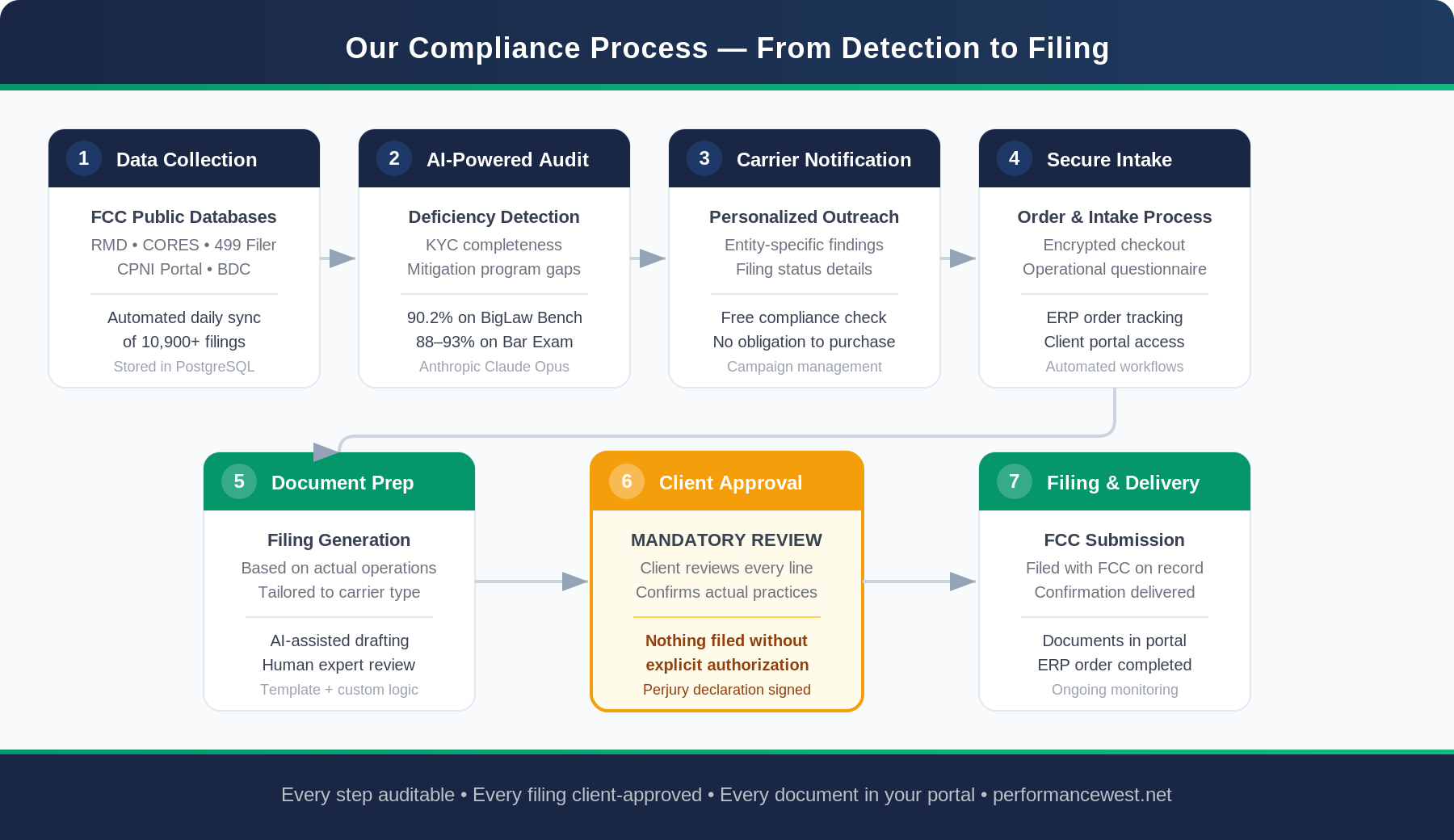
Every step is auditable. Every filing is client-approved. Every document is accessible through our ERP-integrated client portal. The carrier has full visibility and full control at every stage. Nothing is filed without the carrier’s explicit written authorization and perjury declaration.
This is not a black box. It is a documented, repeatable process with more safeguards than most law firms offer — and we are transparent about every step because we have nothing to hide.
The Technology Behind Our Reviews
The CommLaw Group’s article implies that automated compliance review is inherently unreliable. The data says otherwise.
Our compliance analysis is powered by Anthropic’s Claude Opus, the same AI model that leading law firms — including Harvey AI, used by elite firms like Allen & Overy, Ashurst, and O’Melveny — rely on for legal work. Here is how it performs against the same benchmarks used to evaluate attorneys:
| Benchmark | Score | Source |
|---|---|---|
| Bar Exam (MBE) 200 questions, NCBE Complete Practice Exam | 88.5–93.5% accuracy | LawNext, March 2026 |
| BigLaw Bench (Harvey AI) Litigation, transactional & contract analysis tasks | 90.2% — highest of any model | Harvey AI, 2026 |
| Perfect Scores (BigLaw Bench) Tasks scored flawlessly on litigation & transactional work | 40% of all tasks | Harvey AI, 2026 |
| GDPval-AA Economically valuable knowledge work (legal, finance) | +144 Elo vs. GPT-5.2 | Anthropic, 2026 |
For comparison: when MIT researchers independently evaluated GPT-4’s bar exam performance, it scored in the 48th percentile of first-time test takers on the essay section. Claude Opus scores in the 90th+ percentile on the same class of questions. These are not the same technology.
Harvey AI — which uses Claude Opus — is trusted by some of the largest law firms in the world for contract analysis, research memos, and motion drafting. In one benchmark test, the model produced over 120 inline citations, each tied to specific passages in source material. This is not a chatbot generating guesses. It is a system that reads regulatory filings with a level of thoroughness and consistency that no human reviewer can match at scale.
The suggestion that technology-assisted compliance review is inherently inferior to manual legal review is not supported by any evidence. It is contradicted by the very firms that The CommLaw Group competes with.
A Note on Professional Responsibility
Under ABA Model Rule 7.1, a lawyer shall not make false or misleading communications about legal services, and any comparison with competing services must be “factually substantiated.” The CommLaw Group’s article claims that correcting an RMD filing could “become an admission that increases exposure” — without citing a single case, enforcement action, or FCC proceeding where a corrected filing created liability for a carrier. That is an unsubstantiated claim designed to discourage carriers from using a competing service.
Under the Lanham Act (15 U.S.C. § 1125(a)), commercial disparagement — publishing false or misleading statements about a competitor’s services that cause economic harm — is actionable with damages up to three times actual losses. Under state law, tortious interference with prospective business relations applies when a party intentionally disrupts another company’s customer relationships through wrongful means.
Virginia’s Rules of Professional Conduct — which govern The CommLaw Group as a McLean, Virginia firm — mirror these standards. Rule 8.4(c) provides that a lawyer shall not “engage in conduct involving dishonesty, fraud, deceit or misrepresentation.”
We would prefer to compete on the merits. If that is not possible, we are prepared to protect our business through every available legal channel.
Check Your Own Status
We encourage every carrier to verify its own compliance. Our free compliance check takes minutes — no purchase required, no obligation, no billable hours.
Carriers who need help correcting deficiencies can work with us, with a law firm, or with any qualified professional. What they should not do is leave a known-deficient filing in place because someone told them that fixing it is more dangerous than ignoring it.